
The 5 Pillars of Real-Time Retail Execution
Middle East retail is moving to a point where execution delays are no longer “operational issues”; they are direct revenue leaks. In markets like KSA and UAE, brands that cannot see, measure, and correct in-store reality in real time risk losing 10–25% of potential sales to faster competitors.
Why real-time execution matters now
Shopper journeys in the GCC are omni-channel, promotion-heavy, and highly competitive, which means shelf conditions can change multiple times in a single day. At the same time, AI and data-driven retail tools are growing rapidly across the Middle East, with the AI-in-retail market in the region growing above 25% CAGR and enabling early adopters to improve availability, reduce out-of-stocks, and unlock higher conversion.
Pillar 1: Always-on shelf visibility
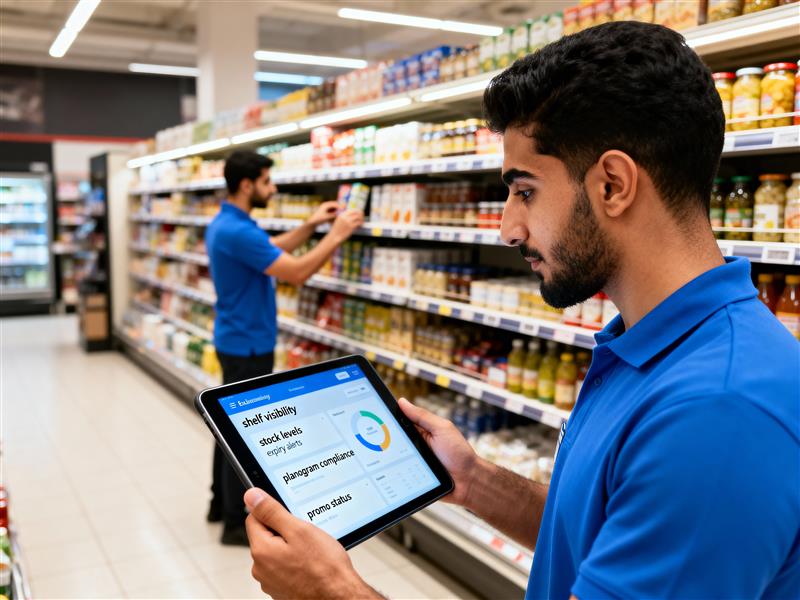
Real-time execution starts with knowing exactly what is happening at the shelf, SKU by SKU and store by store. Brands are shifting from delayed manual reports to photo-led audits, geo-tagged store visits, and digital checklists that capture stock, facings, secondary displays, and pricing in minutes. With image recognition and AI, these photos can be converted into structured data on share of shelf, planogram compliance, and promo presence at scale, instead of relying on subjective field notes.
When a sales head can see in near real time which top SKUs are out-of-stock in priority outlets across KSA, UAE, and other GCC markets, the conversation changes from “what went wrong last month?” to “which stores must we fix today?”. This visibility also helps suppliers have stronger conversations with retailers because they bring data, not just anecdotal feedback.
Pillar 2: Connected field and sales operations
Execution breaks when sales, trade marketing, and field teams operate on different spreadsheets, different WhatsApp groups, and different realities. A real-time model connects promoters, merchandisers, supervisors, key account teams, and distributors on a single, mobile-first platform. Every visit, task, order, and escalation is logged once and visible across stakeholders, which avoids duplication, finger pointing, and missed follow-ups.
In GCC markets with complex modern trade, traditional trade, and growing convenience formats, this connected view is critical. Brands that integrate their field execution tools with sell-out data, distributor systems, or retailer portals can see exactly how in-store actions translate to movement on the shelf, making every visit more strategic and less routine.
Pillar 3: Standardised, tech-enabled processes
Real-time retail execution is impossible if processes remain informal and dependent on individual habits. Many brands in the region are standardising visit journeys, store-level checklists, and survey flows into digital playbooks that run consistently across hundreds or thousands of outlets. Instead of open-ended “market visits”, field teams have structured tasks: audit availability, check pricing, capture competitor activity, validate planograms, deploy POSM, and confirm promo compliance.
By embedding these into a field execution platform, brands remove variability and reduce the risk of missed steps, especially in large outsourced teams. Tech-enabled routing and task allocation also ensure the right stores get more attention, such as high-volume, strategic, or non-compliant outlets, rather than spreading effort evenly without a strategy.
Pillar 4: Closed-loop issue management
Data without action is just an expensive report. The fourth pillar is building a closed loop from “issue detected” to “issue resolved”, with clear ownership and timelines at each step. When an audit or AI alert identifies an out-of-stock on a hero SKU, incorrect price, missing display, or non-compliant planogram, the system should automatically create a task with an owner, deadline, and escalation path.
In GCC retail, where labour rules, nationalisation, and multi-country operations add complexity, this discipline is non-negotiiable. Brands that implement structured workflows report faster resolution times, fewer repeat issues, and better relationships with retailers, because conversations are driven by specific, time-stamped evidence rather than generic complaints.
Pillar 5: Actionable performance intelligence
Leaders do not need more dashboards; they need sharper ones. The fifth pillar is converting raw field data into a small, focused set of execution KPIs that link directly to the P&L. Typical metrics in advanced GCC retail organisations include availability on top SKUs, on-shelf share and facings, promo and POSM compliance, visit productivity, and outlet-level execution scores.
When these KPIs are tracked daily and connected to incentives, coaching, and reviews, behaviour changes. Brands that have combined AI-driven analytics with field execution platforms report improvements like 25% fewer stockouts, 40% better order accuracy, and meaningful sales uplift from better promo and visibility execution.
Why this matters specifically in the GCC
The GCC is one of the most dynamic retail regions in the world, with high smartphone penetration, strong mall culture, and shoppers who move fluidly between offline, online, and social commerce. At the same time, regulatory frameworks around visas, payroll, and nationalisation make it difficult and expensive to scale large in-house field teams, pushing brands to think in terms of smaller, smarter, tech-enabled models rather than simply more people.
This is why many FMCG and consumer brands are choosing to partner with specialised retail execution and sales outsourcing providers who bring not just manpower, but ready frameworks, compliant staffing models, and proprietary technology stacks. These partners can operationalise the five pillars, including visibility, connected teams, standardised processes, closed-loop action, and performance intelligence, much faster than a brand can build alone.
Turning the 5 pillars into a roadmap
To move from theory to practice, a GCC brand can use the five pillars as a simple roadmap. First, measure the current execution gap through a structured audit over 60–90 days to understand availability, visibility, and compliance by channel and country. Second, define the 10–15 execution KPIs that matter most. Third, deploy or upgrade a real-time field execution platform. Fourth, re-architect staffing and workflows around closed-loop action. Finally, embed performance intelligence into weekly and monthly leadership rituals so execution becomes a standing agenda item, not an annual project.
In a world where shoppers judge brands shelf by shelf and visit by visit, real-time retail execution is no longer a “nice-to-have operations project”. It is a competitive advantage that separates brands that merely ship products from those that actually win in-store, every day, across the Middle East.